- Intro
- India borrowed ideas from other constitutions
- World Bank's latest update on reclassification of countries on PCI
- 1. World Bank Income Thresholds
- 2. Per Capita Income (PCI) & Status Comparison
- Key Takeaways
- Economic Policies that helped the countries to move into UMIC
- 1. Vietnam: Export-Led Manufacturing & Open Trade
- 2. The Philippines: Services, Structural Liberalization & Infrastructure
- 3. Sri Lanka: Post-Crisis Stabilization & Structural Recovery
- Economic Polices that India can borrow from other countries
- 1. Fast-Track Industrial Licensing & "Plug-and-Play" Infrastructure
- 2. Vocational & Dual-Apprenticeship Models
- 3. Business-Funded R&D Incentives
- 4. Deep Integration into Mega-Regional Trade Agreements
- 5. Sovereign Wealth-Driven Innovation (The "State as Anchor")
Intro
From the very beginning of this post, I would like to address that some people are going to take offense for comparing India, whose population is nearly 1.4 billion population, with smaller countries whose population is in few tens of millions. It is the same people who will also get offended when comparing India's economy with China's, even though they are of the same size in terms of the population.
They say it is easier to run smaller countries like Vietnam, the Philippines, and Sri Lanka. They also say it is easier to run bigger countries like China if the country is more or less homogeneous. More than 95% of the people in China understand and speak only one language and there is practically only one party that doesn't have to worry about winning elections and holding discussion with opposition in parliament before passing a bill let alone needing a vote from them and worry about how the media portrays them.
I do believe that there is some truth to these statements. But, this shouldn't stop us from looking for policies to adopt from the countries that are working for them and that might work for Indian economy as well even after considering the factors like population size and diversity of our country.
It is obvious that, If we find anything that we can adopt, we might have to customize it to our economy first. We have gone from Government owned and controlled industries to liberalized economy since early 1990s. So, we surely can tailor the policies to properly fit our economy.
India borrowed ideas from other constitutions
In fact, India not only took great inspiration but also did borrow several key features and ideas from the constitutions of other nations and major legal documents. Wikipedia cites 10 countries whose constitutions and governments have influenced India's.
When it did borrow ideas, it didn't shy away from looking at it and thinking "Oh! How can it fit our nation of this size or diversity?". It discussed ideas freely and fairly in the constituent assembly before adopting it.
Even the idea of Liberalization in early 1990s was not necessarily our idea either. It was kind of forced on us. We were in a Balance of Payment Crisis. We did what we had to do to get out of it. It was not really a choice. It was the part of conditions set by IMF and world bank to bring in "structural reforms". We were very desperate to get some foreign-exchange to cover our imports at that time. We did it by pledging significant portion of Gold reserves to the Bank of England and Union Bank of Switzerland.
We should keep our pride aside and try whatever ideas that has the potential to work for us. It doesn't matter whether it comes from allies or adversaries. At the end of the day, everyone stands on the shoulders of the giants.
World Bank's latest update on reclassification of countries on PCI
If you haven't been watching the news last month or only following the news of the protest led by CJP, you are missing out. Srilanka along with Vietnam and Phillipines made it into World Banks' Upper-Middle-Income-Country category. Whereas, India is still stuck at Lower-Middle-Income-Country.
The World Bank classifies economies using Gross National Income (GNI) per capita (calculated using the Atlas method in US dollars) rather than standard Nominal GDP.
Classifications are updated annually on July 1. Below are the current official thresholds (for World Bank Fiscal Year 2027, based on 2025 income data) alongside the income standing of India, China, and the newly reclassified countries:
1. World Bank Income Thresholds
| Income Group | GNI Per Capita Threshold (USD) | Category Description |
|---|---|---|
| Low-Income (LIC) | up to $1,175** | Primary economies, heavily reliant on agriculture/aid. |
| Lower-Middle-Income (LMIC) | $1,176 – $4,635 | Developing economies with expanding industry/services. |
| Upper-Middle-Income (UMIC) | $4,636 – $14,375 | Industrialized developing economies with rising living standards. |
| High-Income (HIC) | > $14,375 | Advanced/developed economies. |
2. Per Capita Income (PCI) & Status Comparison
(Figures reflect World Bank Atlas GNI per capita data for 2025)
| Country | GNI Per Capita (USD) | World Bank Category | Context / Trend |
|---|---|---|---|
| Sri Lanka | $4,670 | Upper-Middle Income | Re-entered UMIC following post-crisis recovery and economic stabilization. |
| Micronesia | $4,760 | Upper-Middle Income | Upgraded to UMIC. |
| Philippines | $4,850 | Upper-Middle Income | Upgraded to UMIC, supported by service exports (IT-BPM) and domestic expansion. |
| Vietnam | $4,970 | Upper-Middle Income | Upgraded to UMIC, driven by export manufacturing and foreign direct investment. |
| Jordan | $5,260 | Upper-Middle Income | Upgraded to UMIC. |
| India | $2,760 | Lower-Middle Income | Remains in the lower-middle-income bracket, steadily progressing toward the upper threshold. |
| China | $14,230 | Upper-Middle Income | Nearing the threshold to transition into High-Income status. |
Key Takeaways
- India's Position: India remains comfortably within the Lower-Middle-Income tier. To reach UMIC status under current thresholds, India's GNI per capita needs to grow from $2,760 to above $4,635.
- China's Horizon: China sits at $14,230—just $146 below the High-Income threshold of $14,375—placing it on the verge of graduating out of the UMIC category altogether.
When this news came out, The Mint put out a YouTube video justifying why the Per Capita Income is low for India. It said "Although India has the 5th largest total GDP globally, its gross national income is divided across 1.4 billion people, compared to Sri Lanka’s ~22 million [03:22]. [00:03:45] – Because of this vast population difference, per capita income metrics take significantly longer to cross threshold levels despite strong overall national growth."
I wonder how they explain China's growth not just in GDP but also in Per Capita Income, which is only $146 less than the threshold for High-Income category. It is not surprising if they reach the high-income status in few years.
“Taking a relatively conservative view, China is likely to reach the threshold of a high-income economy within the next one to two years,” said Sun Xuegong, director-general of the department of policy study and consultation at the Chinese Academy of Macroeconomic Research.
We cannot go by what the head of the government-funded research organization says. They could definitely be a mouthpiece to the Government carrying out the activities of both think-tank and PR firm. So, we can look at the long-term growth trajectory of both China and India.
If you want to compare the growth of Per Capita Income of China and India side by side, Well, it is not even a comparison. Yet, if you still want to do it click here - China & India vs. World Bank UMIC & High-Income Thresholds. Otherwise, don't click. Just read on.
If you don't like me comparing India's growth against China's, I will stay focused on the three countries - Vietnam, Philippines, and Sri lanka.
You have seen the data in the table above published by world bank. That shows status for only this year. It doesn't even show the progress - how far the country has come in terms of Per Capita Income.
So, here is the visual comparison showing the 10-year trajectory of Vietnam, Philippines, Sri lanka and India's Per Capita Income relative to the World Bank's Upper-Middle Income threshold and where India stands among them:
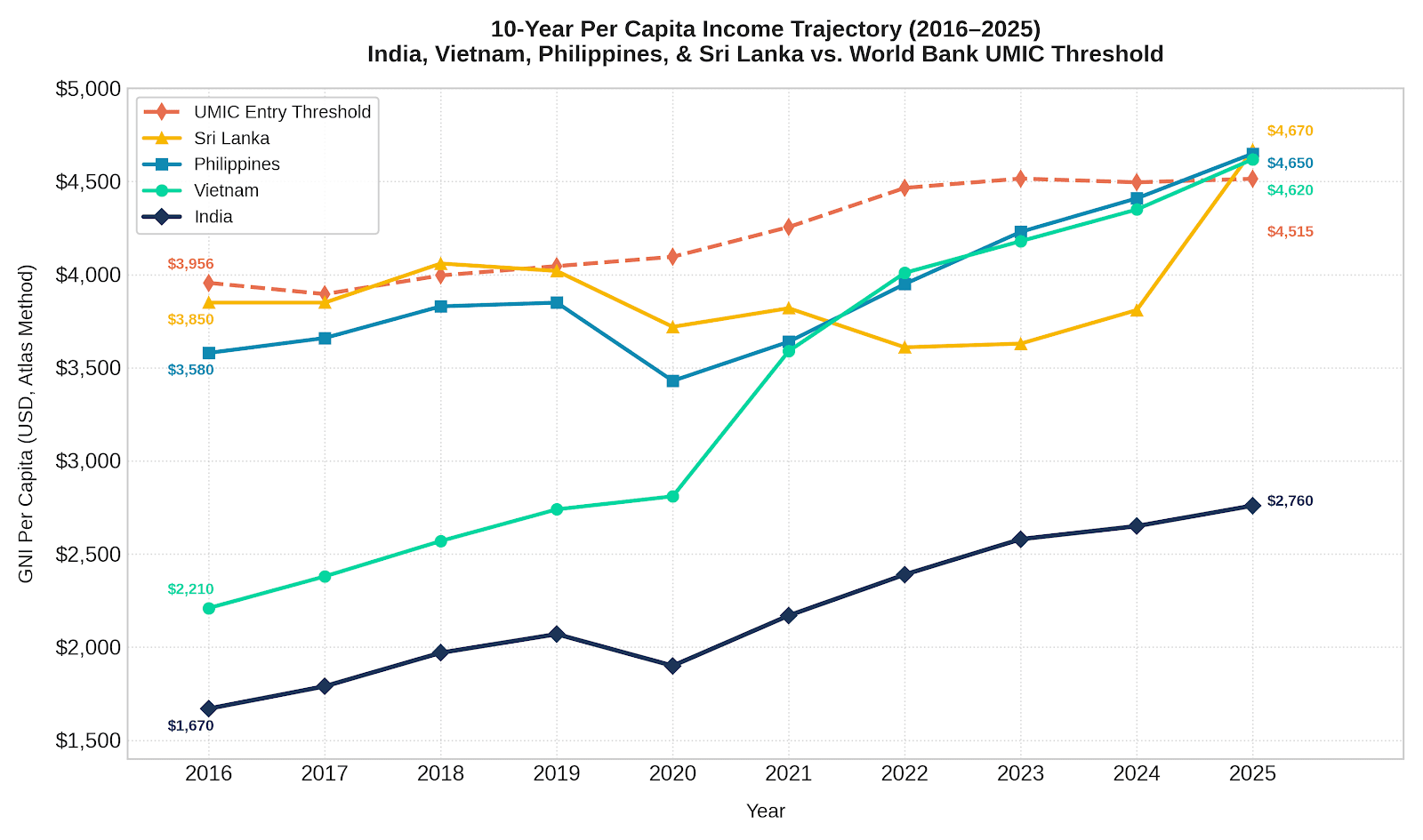
Sri Lanka made a good comeback. Philipplines, not too bad . Well, for India, not bad actually, because if you look at India 10 years ago, India's PCI was less than half of what was Sri Lank's or Philippines'. The Vietnam is one country that stands out from all of them. It started at $2,210 and it more than doubled its PCI after ten years at $4650.
Economic Policies that helped the countries to move into UMIC
This made me look up on Gemini with the prompt - Economic policies of Vietnam, Philippines and Srilanka that helped them boost their economy into UMIC
In July 2026, the World Bank reclassified Vietnam, the Philippines, and Sri Lanka from lower-middle-income to Upper-Middle-Income Country (UMIC) status.
While their economic structures differ—Vietnam relies heavily on foreign direct investment (FDI) and manufacturing, the Philippines on services and remittances, and Sri Lanka on post-crisis stabilization and tourism—all three achieved this threshold through distinct policy frameworks.
1. Vietnam: Export-Led Manufacturing & Open Trade
Vietnam’s path to UMIC status is rooted in four decades of structural economic transformation initiated by the Đổi Mới reforms in 1986.
- Aggressive FDI Attraction & High-Tech Supply Chains: Vietnam introduced generous tax holidays, preferential land leases, and streamlined regulatory frameworks in specialized Industrial Zones and Export Processing Zones. This enabled the country to transition from low-value textiles to high-tech assembly (electronics, semiconductors, smartphones), becoming a vital node in global supply chains.
- Deep Trade Integration: Vietnam actively signed landmark mega-regional free trade agreements (FTAs), including the Comprehensive and Progressive Agreement for Trans-Pacific Partnership (CPTPP), the Regional Comprehensive Economic Partnership (RCEP), and the EU-Vietnam Free Trade Agreement (EVFTA).
- Targeted Public Infrastructure Investment: Sustained state spending on deep-sea ports (e.g., Lach Huyen, Cai Mep), logistics corridors, and industrial power grids reduced transport costs and bolstered regional supply chain resilience.
2. The Philippines: Services, Structural Liberalization & Infrastructure
The Philippines reached UMIC status through broad-based growth across industries, driven by service exports, resilient domestic consumption, and continuous structural reform.
- IT-BPO Sector Incentives & Services Export: Through tax incentives under the Philippine Economic Zone Authority (PEZA), the Philippines established itself as a global leader in Information Technology and Business Process Management (IT-BPM), producing billions in services exports annually.
- Economic Liberalization Laws: The government passed critical legislative updates to open up key sectors to 100% foreign ownership, including amendments to the Public Services Act, the Retail Trade Liberalization Act, and the Foreign Investments Act, alongside opening renewable energy to full foreign equity.
- Aggressive Infrastructure Acceleration: Through the "Build, Build, Build" and subsequent "Build Better More" programs, public capital outlays were raised above 5% of GDP, drastically improving airport, tollway, digital, and mass transit connectivity.
- Macroeconomic Stability & Remittance Integration: Prudent fiscal policies, tax reforms (such as the TRAIN and CREATE laws), and official channels for Overseas Filipino Worker (OFW) remittances fueled steady domestic consumer demand and preserved fiscal stability.
3. Sri Lanka: Post-Crisis Stabilization & Structural Recovery
After experiencing a severe sovereign debt and currency crisis in 2022, Sri Lanka's swift recovery to UMIC status was driven by decisive stabilization policies, debt restructuring, and a rebound in key economic pillars.
- Revenue-Based Fiscal Consolidation & IMF Stabilization: Under an Extended Fund Facility (EFF) framework, Sri Lanka reformed its tax structure (broadening the Value Added Tax base, adjusting income tax brackets) and restored central bank independence to curb hyperinflation and stabilize the Sri Lankan Rupee.
- SOE & Energy Market Pricing Reforms: Transitioning state-owned enterprises (SOEs) toward cost-reflective pricing for electricity and fuel eliminated major fiscal drains and restored balance-sheet integrity to public utilities.
- Service Export & Tourism Revival: Targeted international promotion, visa relaxation policies, and financial sector stabilization catalyzed a sharp rebound in tourism arrivals and apparel exports, rebuilding foreign exchange reserves.
Economic Polices that India can borrow from other countries
India’s economic trajectory has been robust, but to scale from a Lower-Middle-Income Country (LMIC) to an Upper-Middle-Income Country (UMIC) and eventually a developed economy, the country can draw direct policy lessons from structural transformations implemented across East Asia, Europe, and Latin America.
1. Fast-Track Industrial Licensing & "Plug-and-Play" Infrastructure
- Model Countries: Vietnam & Cambodia
- The Policy: Vietnam introduced fast-track investment frameworks (such as Decree 19), establishing single-window clearances with hard statutory deadlines for high-tech manufacturing. Furthermore, they built pre-approved, "plug-and-play" industrial parks where foreign firms can set up production lines in weeks.
- Application for India: While India has scaled its Production Linked Incentive (PLI) schemes and industrial corridors, foreign investors still face state-level land acquisition and environmental clearance delays. India could scale standardized industrial parks with pre-granted environmental permits to capture shifting global supply chains.
2. Vocational & Dual-Apprenticeship Models
- Model Country: Germany
- The Policy: Germany’s Dual Education System (Duale Ausbildung) combines classroom instruction with structured, paid on-the-job training inside companies. Employers design curricula based on active industry demand, guaranteeing a high pipeline of skilled industrial labor.
- Application for India: India faces a persistent mismatch between graduate skill sets and manufacturing needs. Adapting Germany's co-funded apprenticeship framework—where industrial hubs directly co-design ITI (Industrial Training Institute) curricula—would improve youth employability and shop-floor productivity.
3. Business-Funded R&D Incentives
- Model Countries: South Korea & China
- The Policy: China and South Korea heavily incentivize private-sector Research & Development through aggressive tax offsets and state co-investments. In China, businesses account for 77% of total national R&D spending.
- Application for India: India spends around 0.64% of its GDP on R&D, with the public sector carrying the majority of the weight. Encouraging private corporate R&D expenditure—particularly in deep-tech, semiconductors, and green energy—is essential for moving up the value chain from assembly to intellectual property creation.
4. Deep Integration into Mega-Regional Trade Agreements
- Model Countries: Mexico & Vietnam
- The Policy: By signing high-standard multi-country Free Trade Agreements (such as CPTPP, RCEP, and EU FTAs), Vietnam positioning itself as a "connector country". This provides its domestic manufacturers with zero-tariff access to major global consumer markets.
- Application for India: Tariff rationalization on intermediate inputs and capital goods, paired with accelerating bilateral and multilateral FTAs (with the EU and Western trade blocs), would prevent Indian exporters from facing price disadvantages compared to Southeast Asian rivals.
5. Sovereign Wealth-Driven Innovation (The "State as Anchor")
- Model Country: Singapore (Temasek Model)
- The Policy: Singapore uses state-owned investment entities operating strictly on commercial principles to fund early-stage, high-risk domestic innovation, infrastructure, and international expansion without political micro-management.
- Application for India: India can leverage its National Investment and Infrastructure Fund (NIIF) or create specialized sovereign growth funds to act as anchor investors in capital-intensive, high-barrier sectors like commercial AI, advanced biotech, and grid-scale energy storage.
Has India stood by doing nothing while other countries are moving forward? Of course not. India has come with reforms. You can read all about it in here - India’s 2025 economic reforms.